The Pacific Northwest’s dramatic geography — rainforests on one side of the Cascade Range, high desert on the other — doesn’t just shape the weather. It shapes how people build their homes. Architects and designers in Washington, Oregon and Idaho have developed a distinct approach to residential design that pulls directly from the region’s natural materials: wood, water and stone.
Seventy-four percent of designers working in the Pacific Northwest say their clients prefer natural earth tones, according to industry data, with contemporary and organic styles also in high demand. The result is a collection of homes that feel less like structures placed on the land and more like extensions of it.
Wood as a Light, Modern Material
The region’s history with timber runs deep. In the 19th century, the Gold Rush triggered a lumber boom that made logging central to the local economy and gave rise to the term “King Timber.” Wood still shows up everywhere — ceilings, beams, exterior siding.
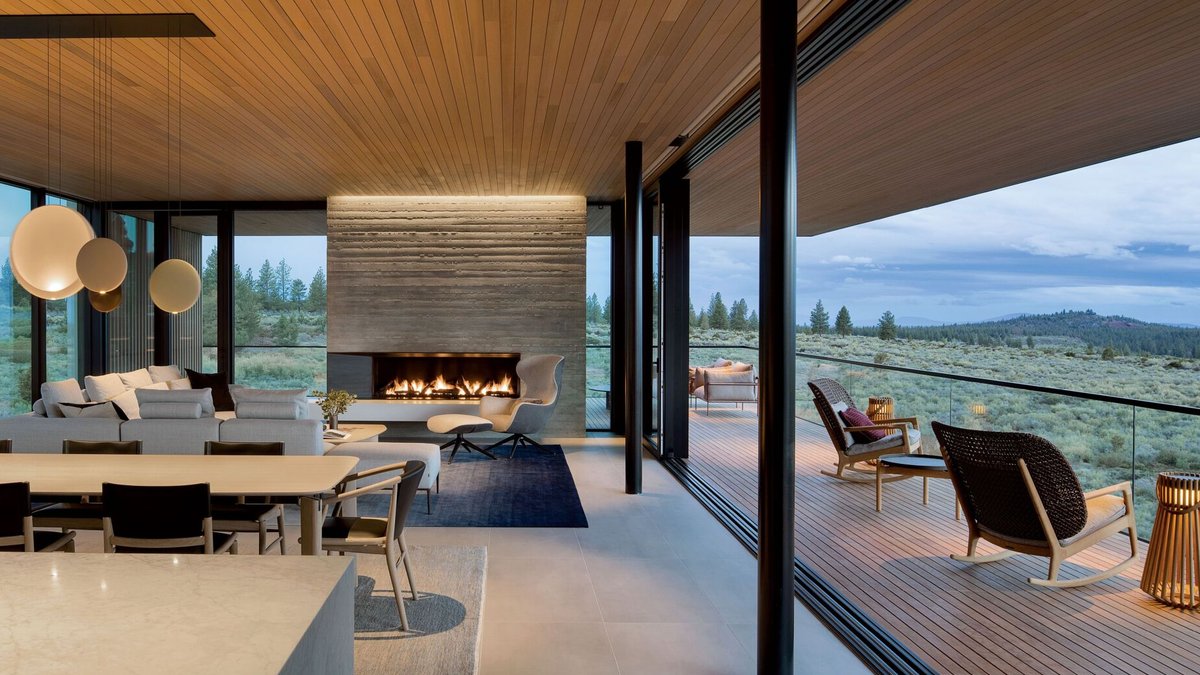
But the look isn’t what many outsiders expect. Two featured projects — a home in Bend, Oregon, by Scott Edwards Architecture and a Bainbridge Island residence by Hoedemaker Pfeiffer — show that wood can feel light, bright and sleek rather than dark or rustic. Architect Steve Hoedemaker said, “In the Pacific Northwest, Modernism found a more human expression: houses of wood, light and setting that feel calm, grounded and deeply connected to the natural world.”
Related: Tropical Modern Home Features Serene Design
It’s a sensibility that runs counter to the heavy, ornate styles found in other parts of the country. The wood here is often left with a visible grain and a natural finish, letting the material speak for itself.
Dealing With Rain Without Hiding From It
The Pacific Northwest is home to some of the wettest spots in the continental United States. Designers respond not by sealing off the outdoors but by creating sheltered spaces that let residents stay outside even when it’s drizzling. Covered decks, protected dining areas and overhangs are standard features.
In Bend, which sits in the high desert and gets more snow than rain, architects Rick Berry and Ryan Yoshida built a pair of raised, covered decks that hover above the setting. “The sheltered decks become spaces for year-round living,” Berry said. The idea is simple: give people a way to be in nature without being at the mercy of the weather.
Late Seattle interior designer Jean Jongeward, sometimes called the “queen” of design in the region, described the area as “this soft green place, like something in a poem.” That softness informs how homes relate to their surroundings — open, calm and unhurried.
Related: Modern kitchens lack key smart home feature
Stone as an Anchor to the Setting
Stone is everywhere in the Pacific Northwest — basalt and granite are abundant, and architects use them to tie houses physically to the ground. In one Washington home, the central structure is bookended with stone forms that echo the rock-strewn shoreline a few steps away. An Oregon residence features a foundation clad in volcanic basalt and a board-formed concrete chimney that reads like a rock tower.
“This allows the house to feel as if it visually nestles into the natural surroundings,” Berry said. The completed house appears to rise from the rock, sand and sagebrush of the desert floor. The effect is deliberate: the house doesn’t sit on the setting so much as grow out of it.
Washington and Oregon have nearly 5,000 miles of shoreline, and architects have made a specialty of connecting waterfront homes to the water. Hoedemaker’s Bainbridge Island project sits on a peninsula, with multiple sheltered and open perches that let residents soak in the view — rain or shine.
Whether it’s Mount Rainier’s chiseled peak or the boulder-studded beaches of the coast, the region’s topography sets the terms. Designers just follow its lead.
