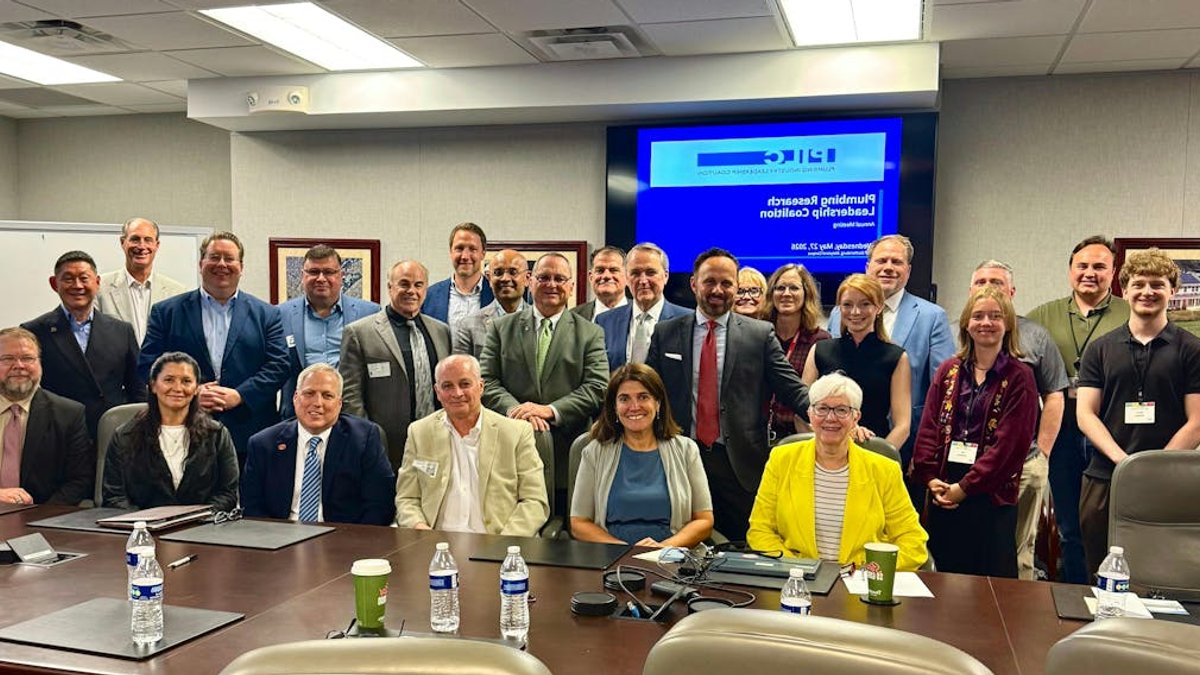
The Plumbing Industry Leadership Coalition gathered at the National Institute of Standards and Technology campus in Gaithersburg, Maryland, to coordinate a unified stance on public‑health protection, liquid‑resource stewardship and the built environment.
Joint priorities take shape
Representatives from leading plumbing and HVAC bodies—including PMI, IAPMO and ASPE—identified four core topics: skilled‑labor pipelines, cross‑border trade, evolving regulations and continued backing for proven federal initiatives.
“When we speak with one voice, we move faster and have a greater impact,” said Kerry Stackpole, chief executive of the manufacturing association.
The dialogue highlighted that a resilient labor pool, clear standards and scientific research are interdependent pillars for future progress.
Trade pressures and supply‑chain tactics
Participants noted that import duties have become a permanent cost factor. Current rates include 50 % on steel, aluminum and copper, 25 % on fabricated derivatives and 15 % on equipment containing those metals.
These charges ripple through the sector, raising material costs by roughly 7 % annually and prompting many contractors to embed price‑escalation clauses or to diversify sources.
Related: AI Skills Gap in Trades
One speaker warned that the upcoming review of the North American trade pact will likely adjust terms, urging early engagement rather than reactive measures.
“Tariffs used to be a line item. Now they’re a strategy,” the executive noted, showing the shift from occasional shock to structural planning.
Funding, research and regulatory outlook
Federal backing for the WaterSense initiative and the plumbing research effort at NIST remains a focal point. Since its 2018 launch, the program claims to have saved nearly 10 trillion gallons of water and over $245 billion in utility costs.
Budget proposals for the next fiscal year suggest cutting the agency’s envelope to about $854 million, though lawmakers have historically resisted cuts of that magnitude.
The House appropriations draft settled near $1 billion, a modest trim that still leaves the research stream intact.
Regulators are also revisiting standards for per‑ and poly‑fluoroalkyl substances. A recent proposal would rescind drinking‑water limits for four compounds while extending compliance timelines for two others.
Related: Jackson Home Offers Panoramic Views of Teton Range
Because the final rule remains unsettled, the coalition stresses that certified treatment devices must stay in place to protect consumers regardless of the eventual federal floor.
In the middle of these discussions, it seems clear that the group’s influence will hinge on its ability to translate technical data into policy language that resonates on Capitol Hill.
Beyond the water arena, lawmakers are examining the impact of large‑scale data facilities on utility grids. A single 100‑megawatt installation can draw water comparable to that used by 2,600 households, prompting a bipartisan push for a transparency act that would require disclosure of energy and liquid‑resource consumption.
Advocates argue that the plumbing field can offer practical solutions—such as efficient cooling loops and reuse systems—to mitigate those demands.
While the agenda feels a bit like juggling cats, the coalition’s next steps include lobbying for four bipartisan bills: the Healthy H2O Act, the Advancing Water Reuse Act with a 30 % investment credit, the Water Conservation Rebate Tax Parity Act, and a workforce‑development measure tied to the Workforce Innovation and Opportunity Act.
Looking ahead, the coalition plans to monitor budget negotiations, track the trade‑pact review and keep an eye on the evolving PFAS rulemaking. The aim is to ensure that the plumbing field remains a cornerstone of safe drinking supplies, energy‑efficient buildings and resilient infrastructure for the coming decades.
