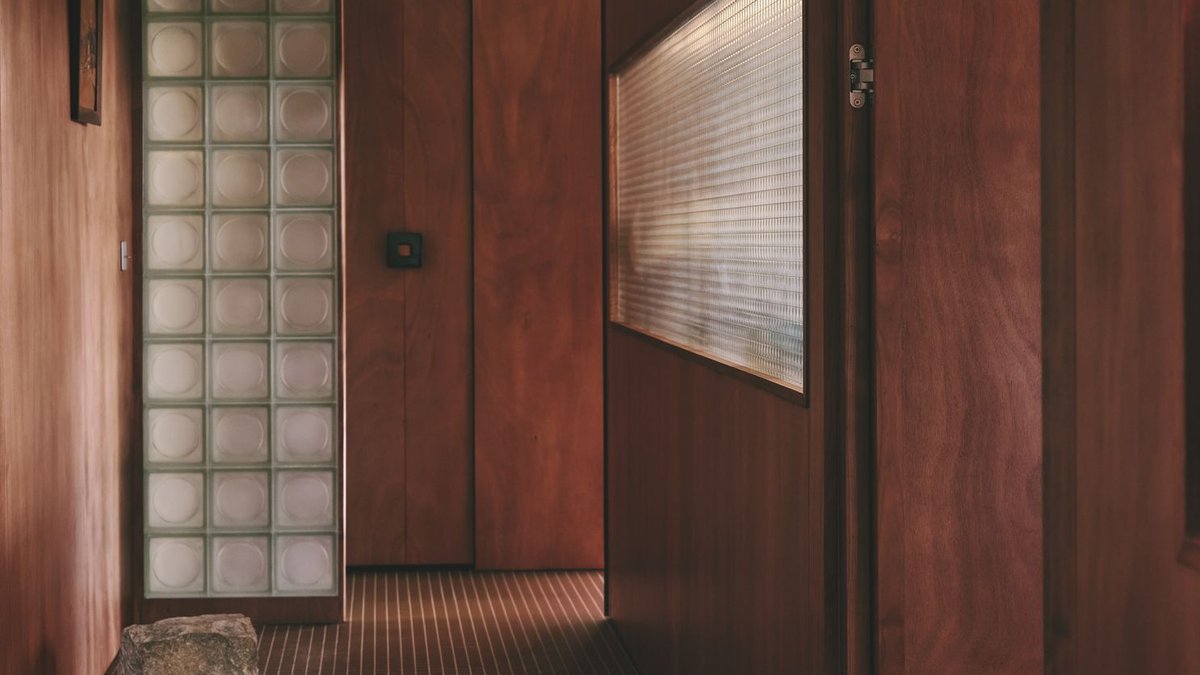
Betyle corrects the common mistakes in period design at Marseille’s Le Figuier residence, merging furniture and lighting from nearly a century of history without imposing a single stylistic era. The studio, launched in 2025 by Carla Romano and Nicolas Cazenave de la Roche, steers clear of both the trap of locking a space into one decade and the chaos of an unstructured historical mashup.
Their process starts with thorough research into each building’s past and its existing features. Every project begins with archival investigations, material analysis, and partnerships with local craftsmen. This method applies to custom furniture, ensuring each creation complements the architecture’s identity instead of adhering to an arbitrary timeline.
In Le Figuier, the outcome is a deliberate blend of periods. A 1935 Art Deco desk lamp by Hendrik Methorst stands beside Marco de Gueltzl’s 1990s sandblasted glass chandelier. Enzo Mari’s 1980s pâte de verre bowl coexists with a pine-and-metal armchair from the same decade, alongside an anonymous stainless steel desk. Contemporary additions, including Betyle’s 2025 Boscaina lamp and Houda x Memòri’s Kasbah Brown wall light, fit naturally without visual conflict.
The collection focuses on material quality and shape rather than chronological consistency. Two 1980s Artemide fixtures, a Garouste & Bonetti resin organizer, and ceramics by Luc Rolland and Alicia Zaton contribute varied textures while avoiding rigid thematic ties. The result feels intentionally modern, as though each object arrived independently rather than by a premeditated plan.
Betyle’s expansion shows its impact. Beyond Le Figuier, the studio has finished the Arcane 17 restaurant in Paris and retail projects for Léo et Violette, with additional residential and furniture commissions underway across southern France. Their ability to honor history while meeting present-day needs could serve as a template for others in the field.
Their distinction lies not just in the era mix but in rejecting artificial unity. No piece is artificially aged, nor does any new design feign belonging to another time. This philosophy may redefine how designers approach heritage spaces, by allowing objects to interact naturally, rather than forcing them into a single story.
The studio’s upcoming furniture maintains its commitment to genuine materials over stylistic uniformity. The test moving forward is whether peers will adopt this approach, treating design history as a tool rather than a constraint.
