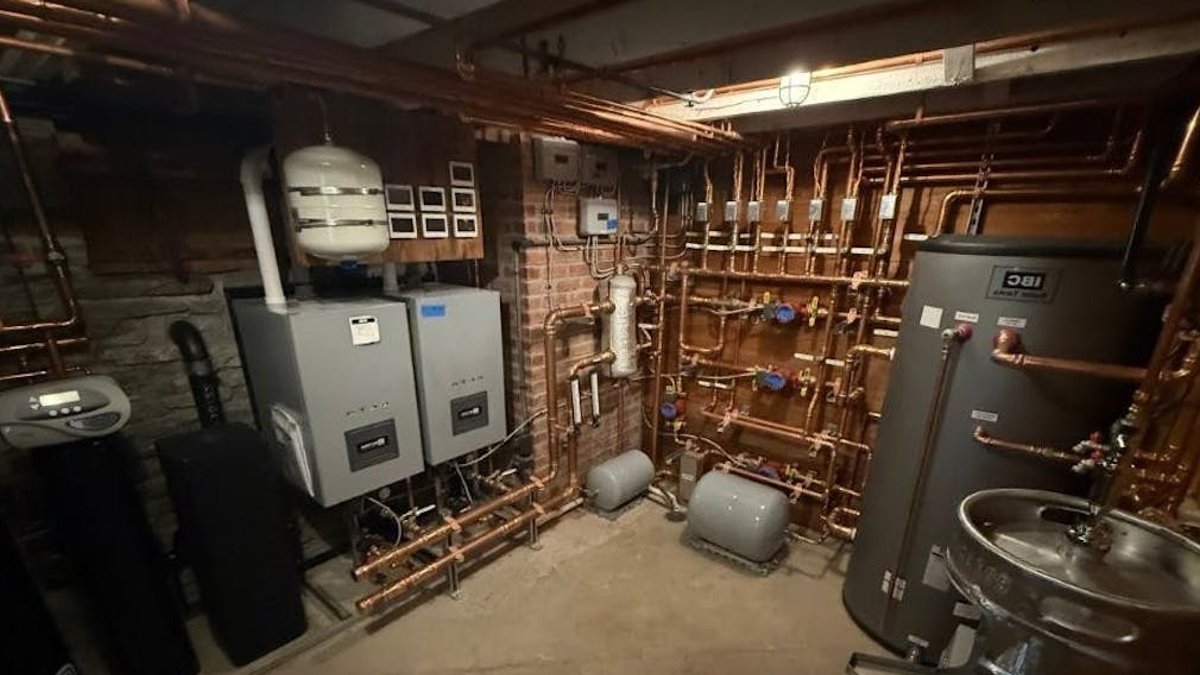
Renovating a 125-year-old Bozeman landmark to blend modern efficiency with vintage charm has become a specialty for local mechanical contractors, who are increasingly tasked with installing custom hydronic heating systems for affluent buyers seeking comfort without sacrificing historical character.
Gutting the Past
When Nathan Bailey of Bailey’s Plumbing and Heating first walked through the historic South Side home, the structure contained an ancient steam system and zero insulation. The project, undertaken for a client willing to invest significantly, required gutting the building to the studs to address safety concerns and achieve performance goals.
During the demolition, the crew uncovered unexpected challenges behind the walls. Live knob-and-tube wiring with scorch marks on the rafters forced a total overhaul rather than a simple patch. Deeper excavations revealed bone fragments mortared into the foundation stones. The renovation, which took approximately four years, involved importing materials from Italy and the UK, including hand-painted tile and Water Monopoly fixtures.
“The place was gutted to the studs,” Bailey recalled. “It was one of those projects that kept giving us surprises the deeper we dug.” The entire shell was spray-foam insulated, and an energy recovery ventilator was installed to ensure a high-performance envelope.
Related: PILC pushes for stronger industry health standards
Hydronic Design in a Historic District
Because the property sits in a historic district, heating design had to respect the architecture while delivering premium comfort. The first and second floors feature filigree-covered cast-iron radiators imported from England to match the aesthetic. Bathrooms, a mudroom, and a kitchen nook utilized in-floor radiant heat.
On the third floor, staple-up radiant tubing with aluminum heat transfer plates was used extensively. The basement, designed with a “steampunk” industrial theme, remains technically unheated but features exposed copper piping ranging from .75 to 1.25 inches in diameter. This setup provides enough radiant heat to keep the space comfortable during Montana winters.
The mechanical heart of the home is located in the basement, which houses two 180 MBH ALTA condensing boilers. These units feature a 10:1 turndown ratio, which helps manage the widely varying zone loads and supply water temperatures. The ALTA boilers are particularly suited for high-elevation locations like Bozeman, avoiding the combustion de-rate issues common with competitive models at 4,800 feet above sea level.
Outdoor reset technology is used to continuously adjust supply water temperature based on weather conditions. This approach keeps water temperatures low during mild days and increases them only when necessary, improving efficiency and comfort while reducing energy use. The system serves seven heating zones and two snowmelt zones.
Managing Snowmelt and Controls
Exterior comfort was addressed with a dual-zone snowmelt system. One loop covers the rear walkway to a detached garage, while the second warms the front walkway, city sidewalk, and curb. Both loops are piped with .75-inch PEX tubing. When city plows push snow to the curb, it melts immediately rather than piling up.
Related: Contractors Adapt to New Electrification Landscape
The snowmelt is controlled by a DS-2 sensor mounted on a fence, which activates the system only when moisture is detected at temperatures below 36°F. The loops remain cold until this trigger occurs, preventing unnecessary energy consumption. Both snowmelt zones are isolated from the rest of the hydronic system by a plate-and-frame heat exchanger.
While the mechanical room contains complex components like expansion tanks, a Caleffi hydro separator, and Grundfos circulators, the homeowners requested that the equipment remain largely invisible. A Honeywell RedLINK™ system provides remote access via smartphone or tablet, allowing for monitoring and adjustments without disrupting the living space. Wireless sensors are hidden throughout the home, feeding data back to the mechanical room modules.
This reliance on remote access and specialized design meant the project required more oversight than standard installations. Shipping delays and trans-Atlantic component sourcing added to the timeline, requiring constant coordination between the team and the homeowners.
Despite the challenges, the final result offers a seamless blend of old-world character and next-level performance. The property serves as a clear example of how modern hydronic technology can accommodate the specific demands of high-end historic renovations.
