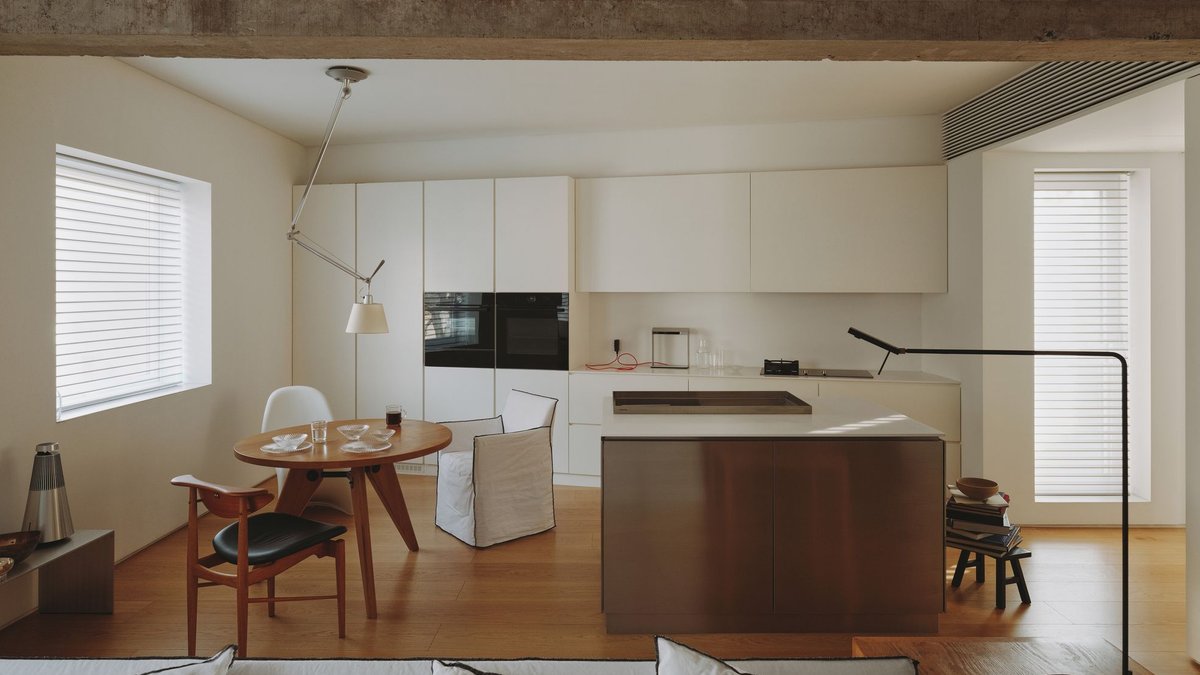
A creative couple in Shanghai transformed their 1941 apartment with the help of their friends, Onoaa Studio. The firm, founded by Gao Ya and Chen Peng in 2019, is also a long-time friend of the clients. This relationship became central to the project, which is located in the Friendship Apartment. The building’s original Chinese name, “Liangyou,” translates to “good friends,” a fitting coincidence for a project built on trust.
A New Foundation for an Old Building
The apartment sits on the corner of Fuxing West Road and Yongfu Road. The four-storey brick-and-concrete structure was built in 1941. It gained two more floors in 1991. The owners were drawn to its lively surroundings, including street trees and local shops. This dense, active community became the design’s starting point.
Onoaa Studio views a home as a set of relationships between the building, its people, and their habits. The firm did not give the apartment a new identity or treat its history as a theme. Instead, they recomposed the space, deciding what should stay and what needed to change. The original structure, beams, and columns were all retained. They remain exposed, not as heritage props, but as functional parts of the new plan.
Designing for Life, Not Layout
Onoaa Studio describes its preservation method as a working approach, not a gesture. Many renovations scrub a building clean or use its past as decoration. This project does neither. The result is a space that respects its history while adapting to modern life.
The friendship between the clients and designers proved essential. The designers didn’t need a questionnaire to understand their lifestyle. They had observed it for years through shared meals and work. They knew how the couple conversed, moved between social and private time, and balanced work with home life.
This understanding led to an open-plan interior. There are no rigid, closed-off rooms. The space operates as a flexible system. Different activities can happen, overlap, and swap throughout the day. The owners continue to adjust the layout as their needs change. Materials are paired to create clear contrasts, but without forcing a single, unified look. The apartment makes a convincing case that a home’s true form comes from the relationships that unfold within it.
