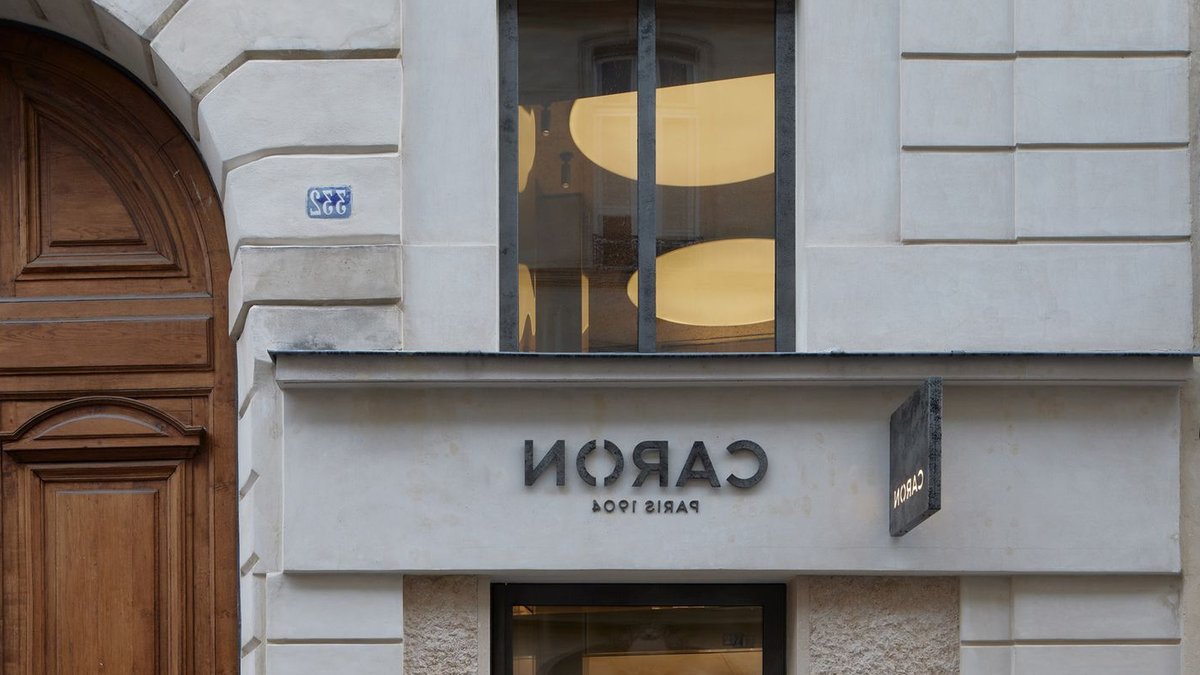
Casper Mueller Kneer reimagined Caron’s Paris flagship at 332 Rue Saint-Honoré as an ever-evolving runway. The London- and Berlin-based studio, specializing in turning theatrical designs into permanent retail, designed a space where every element, the glowing central column, the mirrored surfaces, exists solely to highlight the perfume, not the building itself.
Olivia de Rothschild, Caron’s creative director, gave the team a clear directive: create a space dedicated to the act of smelling, free from distractions. The outcome is a minimalist interior where Art Deco elements, stepped walls, sharp geometric lines, and integrated lighting, form a monochromatic backdrop. Stainless steel panels reflect perfume bottles as shimmering, distorted shapes, while floor-to-ceiling mirrors elongate the space, making it feel far larger than its actual size.
A centerpiece of the design is a perfume fountain, the first of its kind in a fragrance retailer. Crafted by Atelier Blam, it consists of hand-frosted glass tubes arranged in a circular formation, illuminated from behind and filled with Caron’s signature scents. This installation serves dual purposes: it acts as both a display and a customer service station, allowing shoppers to refill their bottles, a hallmark of Caron’s service, while its form pays homage to the brand’s artistic glassmaking traditions.
The store is organized into three distinct areas. The front and back sections showcase the Collection Merveilleuse and Pour un Homme lines, respectively. The rear houses cash registers, archive displays, and a staircase leading to a first-floor VIP lounge. Unlike conventional retail spaces, the design eliminates unnecessary clutter, instead framing the store as an extension of a perfume advertisement, where the product remains the sole focus.
The question now is whether this approach, merging retail with a performance-like experience, can drive sales. A runway set exists only for moments, but this store must sustain the same level of engagement every day. If successful, it could set a new standard for how luxury fragrance brands occupy physical spaces.
The exterior of the store is unassuming, featuring a small vitrine of diorama displays near the entrance. Inside, the main attraction is the illuminated central column, visible from the street, drawing passersby into an environment where perfume isn’t merely sold; it is experienced as a staged performance.
